Showing posts with label bullying. Show all posts

Thursday, March 14, 2013

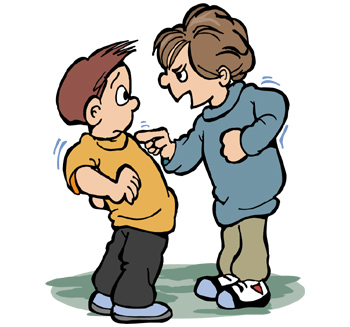
Children who Bully


Add caption
 
While bullying is common among children, it is no longer tolerated nor considered to be a part of growing up as in past decades. The University of New Hampshire Cooperative Extension fact sheet, “Why Do Some Children Bully Others?” provides information on children who bully.

Bullying is an early form of aggressive, violent behavior. About 16 percent of students in the Unites States are involved. Of those, seven percent are the bullies and nine percent are the targets of bullies. By 24-years-of-age, 60 percent of bullies have criminal records. In comparison to other children, bullies grow up to have more arrests for drunk driving, domestic violence and child abuse.

Bullies are aggressive children. They view violence as an okay way to interact with other children. Many bullies are impulsive and active. Some are physically abused by their parents or other adults. Some have parents who are bullies. Bullies often copy the behavior they see or experience at home.

Possibly because they don’t know what to do, parents and other adults may ignore the behavior of bullies. Since they aren’t’ disciplined, bullies learn it is okay to act aggressively towards others.

Bullies harass others because of their race, gender, ethnicity, physical attributes, sexual orientation or personality characteristics. Anyone that the bully considers “different” can become the target. Bullying can be pushing, kicking, hitting, making threats, name calling, spreading rumors, and teasing or humiliating others.

Both boys and girls are bullies. Boys tend to use more physical behaviors, while girls are more indirect, such as spreading rumors or leaving a child out of activities. Bullying usually starts in the preschool years. It escalates during elementary school and peak during middle school.

 You can download the entire publication at http://extension.unh.edu/family/parent/SApubs/bully.pdf.

Wednesday, March 14, 2012

My child is a bully. What can I do?

Use positive discipline. If you hit your child, be prepared for your child to hit others. If you have used physical punishment in the past, stop. Tell your child the new rule in the home for all family members is, “no hitting.” Teach your child that hitting, pushing, and teasing others is never okay.

Take a parenting class to learn how to discipline without hitting or spanking. Parenting classes in Hillsborough County can be found at: http://hillsboroughfcs.ifas.ufl.edu/ParentingClasses.html

If your child steal or damages another child’s clothes or toys, have him or her restore them or replace them. Require your child to do additional chores to pay for replacing the victim’s property or take away his or her allowance for several weeks to pay the cost.

Help your child develop empathy and caring. It’s important they learn how their behavior affects others. Bullies begin to think about their behavior and the outcomes of their behavior when adults discuss situations and ask questions. “What could you do when you want to feel powerful instead of hitting and shoving someone?” or “You are a good kid, but it’s wrong to hit others. Can you think why you might do this?” are good questions.

Tell him or her that you won’t allow the bullying to continue. Tell your child:
·         Stay away from the child or children you have harassed or bullied.
·         You can’t be with other children who are bullying with you.
·         Go directly to school and come directly home. If possible, make arrangement for an adult to go to and from school with your child.
·         I (or another adult) will supervise you. If other children play in our home, you must play where I can see you.
·         If you visit another child, I will call the child’s parent to see if he or she is at home. You will be closely supervised.


Wednesday, July 20, 2011

Cyberbullying

Bullying, defined as aggression on a continual basis between peers where one has a power advantage over another, is common among children and adolescents. Cyberbullying involves using electronic communication for these ends:


• teach someone a lesson

• put others down

• play pranks

• share personal information publicly

• stalk someone

• commit other overt attacks upon a person

Teens who cyberbully may feel that cyberspace is an impersonal place to vent, and, therefore, consider it less harmful than face-to-face bullying. However, cyberbullying can be very destructive. Examples include middle school teens starting a poll with their classmates, casting online votes for the ugliest girl in the school or unsolicited videos or photos taken in a locker room are posted on YouTube or forwarded by media messaging. In addition, threats or hateful words travel easily through cyberspace in e-mails or cell phone messages (voice or text) from an unrecognized phone number. Ironically, most cyberbullying takes place within a teen's immediate social circle and those most likely to be victimized are highly active in social networking sites, blogs, and chat rooms

About 25% of teens report being victims of cyberbullying, and over a third (35%) of teens reported feeling unaffected by it. Yet, the vast majority of victims reported feelings of:

• frustration,

• anger,

• sadness, and

• social anxiety

In addition, as is the case with online sexual solicitation, preteens are more likely to suffer psychologically from cyberbullying than older teens.

To down load the publication For Teen Safety in Cyberspace, written by Kate Fogarty, assistant professor, Department of Family, Youth and Community Sciences, University of Florida go to: http://edis.ifas.ufl.edu/pdffiles/FY/FY84800.pdf


Tuesday, October 5, 2010

Outcomes of Bullying

Bullying has been around for generations and has in the past been viewed as a rite of passage or harmless youthful behavior that makes children stronger or tougher. Now bullying is considered a public health problem that affects as many as 30% of students and has serious negative impacts for the bully and for the victim.

Children who are the targets of bullying have low self-esteem and often endure serious emotional problems, such as depression and anxiety. They cannot concentrate on school work or may decide not to go to school at all.

Research conducted by the National Information Institutes of Health reported that children bullied once a week or more were more vulnerable to poorer health, depression, anxiety, insomnia, and thoughts of suicide than children who were not bullied. Some of these problems last into adulthood.

Young people who bully also experience problems. They are more likely to be involved in other problem behaviors, such as smoking and drinking alcohol, and they don’t do as well in school. They are also more likely to engage in criminal activity as adults.

Parents need to be aware of the signs of bullying, which include (but is not limited to) a drop in grades, lack of interest in school, withdrawal from social activities, feeling ill in the morning, has unexplained cuts or bruises, has money missing or “lost,” stops eating, or is bullying other children or siblings.

Schools can be successful in reducing bullying by establishing clear rules against bullying and by increasing adult supervision where bullying usually happens – in cafeterias, bathrooms, hallways, stairwells and school yards.

Parents can make contact with the child’s school or visit the Hillsborough County Bully-buster’s Website for more information at http://www.hillsboroughcounty.org/bullybusters/.